
What 40 Years of Designing New Orleans Hotels Teaches You About Its Future
Campo Architecture partner Miriam Salas on the city’s hotel market reset, the secret weapon hiding in plain sight, and why the best days for New Orleans may still be ahead.
Why It Matters
New Orleans is in the middle of one of the most significant reshuffles in its hospitality history. Hotels are trading at deep discounts, brands are pausing new builds, and some of the most iconic properties in the city are quietly changing hands. And yet — the smart money is circling.
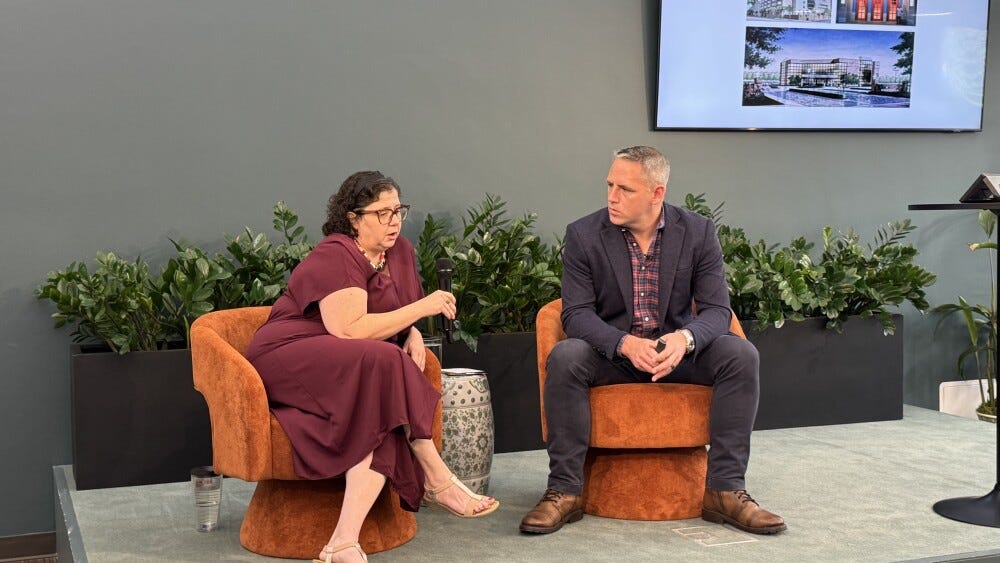
To understand what is actually happening, KW New Orleans sat down with Miriam Salas, Partner at Campo Architecture & Interior Design, a firm that has shaped the look of hospitality from New Orleans to Anchorage over the past 40 years. She has designed projects for Marriott, JW, and Sonesta, revived abandoned power plants into luxury hotels, and watched the city rebuild itself after Katrina. When she reads a room, she means it literally.
Miriam Salas
Partner — Campo Architecture & Interior Design
Fulbright Scholar, Tulane University. Began her career designing a JW Marriott in Caracas. Joined Campo after Venezuela’s 2002 national strike stranded her in Miami. Now directs a 20-person national firm with projects from South Beach to Anchorage. Named one of the top 50 most influential women in Louisiana. Year 23 at the firm she was given two months to try.
The State of Play
New Orleans hotels are moving — just not in the way developers imagined three years ago.
New development is largely on pause. Tariffs, financing uncertainty, and labor shortages have pushed most owners to renovate existing properties rather than break ground on new ones.
Distressed assets are trading fast. Le Pavillon sold for approximately $42 million shortly after a $19 million renovation. The Virgin Hotel, which cost around $80 million to build, was listed for roughly $44 million. These are casualties of over-leveraged pre-COVID pro formas.
Proposal requests are picking back up. Salas notes her firm is fielding more RFPs than in months — developers getting their teams in position for when the climate shifts. The engines, she says, are running.
Boutique is beating branded. A hotel like the Chloe can charge $800 one week and $1,200 the next. A Courtyard is often capped well under $200. The rate ceiling that comes with a major flag is now a structural disadvantage.
If you have cash, this is the time to buy.— Miriam Salas, Partner, Campo Architecture & Interior Design
The Secret Weapon Most People Overlook
If there is one tool that separates Louisiana hotel development from nearly every other market in the country, it is the state’s historic tax credit program — and very few people outside the industry understand how powerful it is.
Louisiana’s State Commercial Historic Tax Credit currently offers a 25% credit on eligible rehabilitation expenses for qualifying historic buildings (35% in designated rural areas). Stacked on top of the federal 20% Historic Tax Credit, a developer rehabbing a historic income-producing property can access up to 45% of their investment back in tax credits before a single room is booked. Those credits are fully transferable and can be carried forward up to five years under Louisiana law.
A 2025 report by PlaceEconomics found that Louisiana’s historic tax credits generated more than $4.4 billion in investment between 2017 and 2024 — and every $1 in state credits produced $5.38 in direct private investment. Louisiana ranked #2 in the nation for completed federal historic tax credit projects in 2025, trailing only New York.
Key numbers:
45% — Combined state + federal historic tax credits on qualifying Louisiana rehab projects
$4.4B — Investment generated by Louisiana historic tax credits, 2017–2024
#2 — Louisiana’s national ranking for completed federal HTC projects in 2025
419 — Historic buildings rehabilitated in Louisiana, 2021–2025
Most of our work being historic, it can benefit from historic tax credits — which in some states like Louisiana can be 45% of their investment. That seals the deal, because that’s 45% less they have to ask the bank or their partners for. They have equity up front.— Miriam Salas, Partner, Campo Architecture & Interior Design
Caesars, Four Seasons & The Shakeout
The opening of Caesars New Orleans — a $435 million transformation of the former Harrah’s site — is reshaping the competitive map at the top of the market. The project added 340 new hotel rooms, a Nobu Hotel, and a dining and entertainment complex anchored by Emeril Lagasse and Bobby Flay.
Salas believes Caesars is about to absorb significant market share from the Four Seasons, whose residential condos have struggled at their price points — a pro forma that simply didn’t account for a casino resort of that scale arriving next door. The Nobu Hotel inside Caesars, positioned primarily for high-end guests, is a luxury tier unto itself.
The Design Shift Changing Everything
“It’s not about the transaction, it’s about the experience.” That principle is showing up in blueprints everywhere: reception desks are being hidden or eliminated entirely, and lobbies are now conceived as social destinations first.
Campo’s JW Marriott in Savannah — Salas’s favorite project — converted an abandoned power plant into a luxury hotel: 60–80 foot ceilings, exposed steel trusses, industrial catwalks repurposed as corridors to guest rooms, and a 107-foot dinosaur skeleton hanging from the ceiling. Every rule of luxury hospitality was broken — and the result is something genuinely irreplaceable.
We reused the industrial catwalks as a catwalk to access your room. In a luxury hotel, you want to see a very hands-on carpet in your corridor. Here you have a metal catwalk — but it works in the space.— Miriam Salas, Partner, Campo Architecture & Interior Design. After years of avoiding small projects, Campo has just taken on a 14-room boutique in New Orleans. Their smallest project ever. Salas says it is the right project.
The Play Nobody Is Talking About: Downtown Offices → Hotels
Downtown New Orleans has a quiet occupancy problem. Office towers that claim high occupancy often have large sections of genuinely underutilized space — a reality well known to anyone walking the CBD on a weekday evening.
In San Antonio, Campo compressed office tenants into the lower floors of a 21-story building and converted the rest into a dual-brand hotel — an AC Hotel paired with an Element — sharing back-of-house operations while presenting different products to different guests. New Orleans has no shortage of those buildings.
The Omni Question
The proposed Omni Hotel — slated for the old sugar mill site adjacent to the convention center — is the answer being floated to grow the city’s room count for future Super Bowl bids. The Ernest N. Morial Convention Center needs roughly 10,000 rooms to compete for the largest national conferences. A large-scale hotel at its doorstep is probably necessary, even if the site selection isn’t ideal. The broader riverfront development project remains the more exciting long-term variable; if and when it moves, Salas believes it will fundamentally redraw the city’s map.
The Bottom Line
New Orleans hospitality is not broken — it is repricing. The over-leveraged are selling, the cash-positioned are buying, and historic tax credits are providing meaningful equity in deals that would otherwise not pencil. Boutique and experiential product is outperforming branded prototypes. And a firm that has spent 40 years learning when to pivot is back building in its own backyard. The engines, as Miriam Salas puts it, are running.
About this series. KW New Orleans hosts regular conversations with the leaders shaping our city — developers, architects, investors, and operators building the New Orleans of tomorrow. These are the conversations that happen in the rooms most people don’t get invited into.
Be in the Room Where It Happens
KW New Orleans brings together the sharpest minds in real estate, development, and hospitality. If you’re ready to work alongside people building the city’s future — we’d love to talk.
Disclaimer: This article is for general informational purposes only and is based in part on commentary shared during a KW New Orleans conversation with Miriam Salas, Partner and Studio Director at Campo Architecture & Interior Design. Hotel market conditions, project timelines, financing assumptions, permitting status, and brand strategies may change. Nothing in this article is legal, financial, investment, or development advice. Readers should consult the appropriate licensed professionals and official project sources regarding specific decisions.
This article was originally published on our website, which can be accessed here.