
Walker’s Imaginarium: Children’s Hospital Builds Joy
COMMUNITY & CITY BUILDING — CHILDREN’S HEALTH
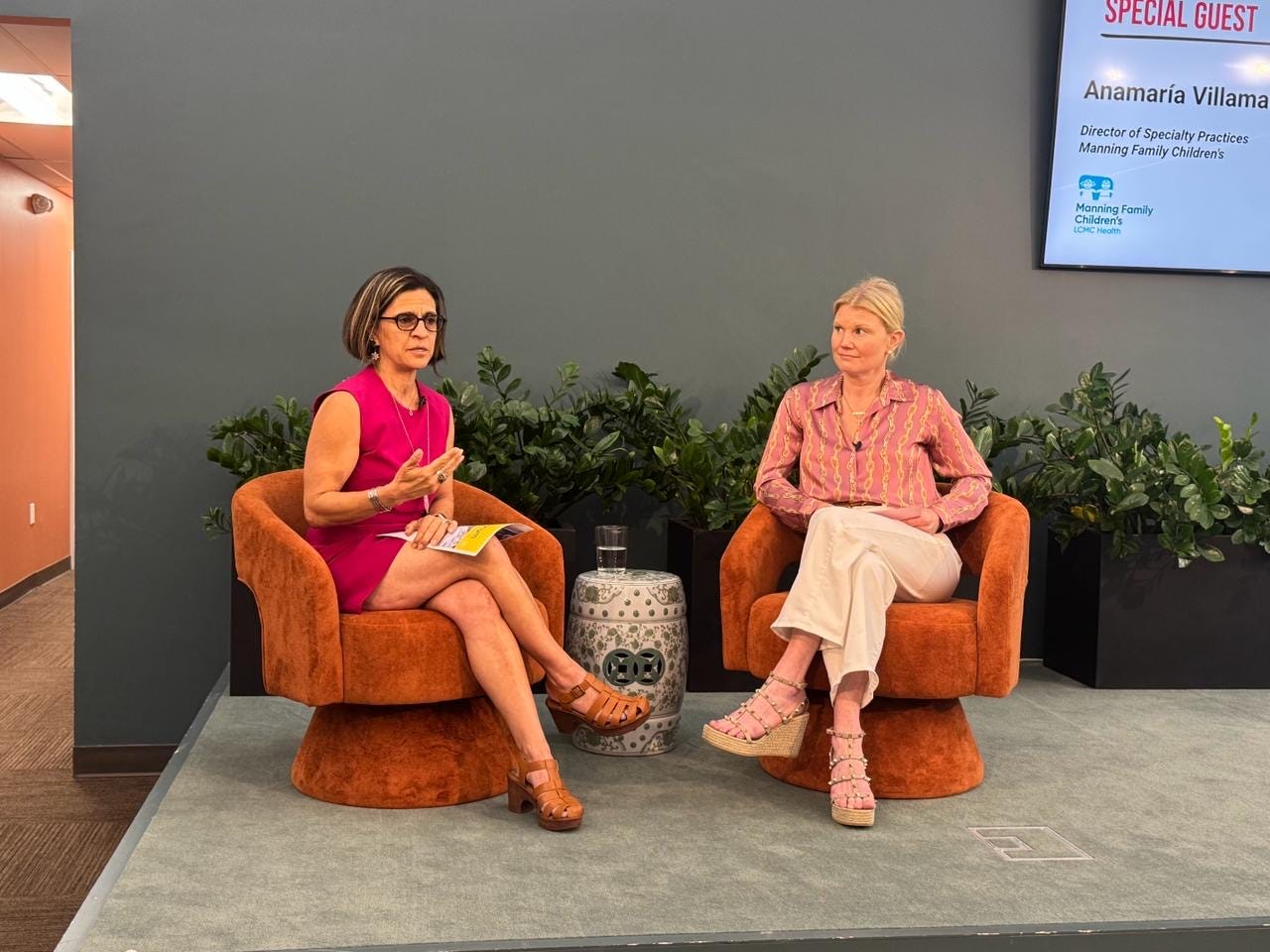
Anamaría Villamarín-Lupin, Director of Specialty Practices at Manning Family Children’s, on Walker’s Imaginarium, the programs serving New Orleans families every day, and what a sick eight-year-old’s dream is about to become reality.
INTERVIEW BY LAUREN DOUSSAN, PRINCIPAL, KW NEW ORLEANS · KW NEW ORLEANS · APRIL 2026
WHY IT MATTERS
A children’s hospital is where families go when things go wrong. What Manning Family Children’sis building right now is something different — a 15,000-square-foot play facility born from a child’s wish, a Ryan Seacrest Foundation multimedia studio, and a suite of community programs that reach New Orleans families long before anyone ever needs a hospital bed.
Anamaría Villamarín-Lupin oversees the programs that face outward: the Parenting Center, the GNO Immunization Network, the Miracle League, and the soon-to-open Walker’s Imaginarium. She sat down with Lauren Doussan to walk through all of it — and to tell the story of the boy whose idea started it all.
Anamaría Villamarín-Lupin
DIRECTOR OF SPECIALTY PRACTICES — MANNING FAMILY CHILDREN’S
She was born in Colombia and landed in Connecticut at twelve — a jarring introduction to the United States that she navigated largely by eventually finding a city that felt like home. She followed a boy to New Orleans (her words), fell for the place as hard as the person, and has now lived here for nearly thirty years. After studying psychology at Williams College and earning her Master’s in Social Work at Tulane, she built a career in public service, eventually becoming Deputy Director of the Mayor’s Office of Youth and Family Services, where she helped administer the city’s Early Childhood millage. Manning Family Children’s pulled her into the hospital world, where she now shepherds programs ranging from a 46-year-old parenting center to a 28-year-old mobile immunization network to the Miracle Leaguesports program for children with disabilities. The thread running through all of it: she’d rather talk about the kid who sold lemonade to fight cancer than recite her own credentials.
THE STATE OF PLAY
Manning Family Children’s has reframed its external-facing work under a “community impact” banner — a deliberate shift away from the language of charity toward something that sounds more like partnership. Here’s what that looks like in practice.
Walker’s Imaginarium is a 15,000-square-foot children’s museum-style facility under construction at the hospital. Pile driving began in July 2025, and a mid-November 2026 opening is projected. It will be free for patients and open to the public one day per week.
The Seacrest Studio — the 15th installation of the Ryan Seacrest Foundation’s multimedia production program — will be housed inside Walker’s Imaginarium, making it the only such studio nested inside a children’s museum inside a hospital.
Thrive Kids embeds mental health practitioners and nurses in New Orleans public schools, with care coordinators who follow up with families, remove transportation barriers, and connect children to ongoing care.
The Morgan Ray Center of Hope, the hospital’s child advocacy center for victims of abuse and trafficking, recently received a $1 million gift from Trey Carter to sustain its work.
“Our CEO likes to say that we are in the business of making sure kids have birthdays for the rest of their lives. And so that’s our impact, right? More birthdays.” — ANAMARÍA VILLAMARÍN-LUPIN, DIRECTOR OF SPECIALTY PRACTICES, MANNING FAMILY CHILDREN’S
WALKER BEERY & THE DREAM THAT BUILT IT
Every capital project has a ribbon-cutting. Walker’s Imaginarium has something rarer: a founding story that is genuinely hard to forget.
Walker Beery was a New Orleans boy diagnosed with a rare, aggressive form of brain cancer. He spent long stretches at Manning Family Children’s, and during that time, a simple act of kindness from a fellow patient moved him enough to want to pay it forward. He started selling lemonade and built a movement — Kids Join the Fight — that rallied children to raise funds against cancer. The kapow signs you may have spotted around Uptown? That was Walker.
He also had an idea about the hospital itself. Visits from friends were cramped and limited. He wanted something more — a playground, a place to have fun. The hospital’s CEO at the time took the conversation seriously and pushed Walker to dream bigger. What emerged from that exchange, over time, became the vision for a 15,000-square-foot facility with a butterfly sculpture, a Louisiana porch-life play area, a Mardi Gras float, an air boat simulator, a nine-hole mini golf course, and a stage — because Walker loved to dance. Walker passed away at age eight in 2021. He did not live to see the ground broken. Construction started in July 2025.
The philanthropic engine behind the project is Kids Join the Fight, the 501(c)(3) Walker founded, which provided the seed funding. Every element of Walker’s Imaginarium has been funded entirely through philanthropy and donations — no hospital operating budget, no government line item.
WHAT’S INSIDE
The design reflects both Walker’s personality and a serious commitment to accessibility — every exhibit was shaped by input from patients, families, medical staff, and rehabilitation teams.
The centerpiece of the entry atrium is a large butterfly sculpture by artist Christopher Scharf, known for large-scale kinetic installations at Burning Man. Visitors sit on an accessible swing — with a wheelchair ramp built in — and as they swing, their movement animates the butterfly’s wings. The wind from those wings causes shimmering LED discs above to flutter. It is the first thing you see when you walk in.
From there: a “porch life” creative play area with a pretend crawfish boil, a performance stage (no food or drink, but plenty of dancing), a Krewe of Walker Mardi Gras float built by the Kern family with pneumatic-tube scarf throws, an oversized foosball table, an air boat simulator, and an interactive LED forest that responds to movement. Artist Alex Beard was commissioned to paint a bayou scene that will be reproduced as wallpaper across two full walls. Outside, under an overhang with fans, sits a nine-hole miniature golf course — all holes fully accessible, two designed as skee-ball-style ramps.
The Seacrest Studio sits inside Walker’s Imaginarium itself — Villamarín-Lupin describes it as “Russian dolls” of fun. The studio will broadcast programming to every patient room in the hospital, and it’s interactive: children who cannot come down to the facility can still participate. The most popular program at every Ryan Seacrest Foundation studio across the country is bingo.
“Walkers will have the secret studio that will open after we open walkers, and that is going to be life changing too. Because it’s the way to bring programs, and we have our own channel, and we’ll be able to broadcast anything and everything that’s happening in walkers and in the studio, because we&#ll have programs to every single room.” — ANAMARÍA VILLAMARÍN-LUPIN, DIRECTOR OF SPECIALTY PRACTICES, MANNING FAMILY CHILDREN’S
THE PROGRAMS ALREADY RUNNING
Walker’s Imaginarium is the headline, but Villamarín-Lupin oversees programs that have been serving New Orleans families for decades — most of them available to the community regardless of whether you ever set foot in the hospital.
The Parenting Center, founded in 1980 in partnership with the Junior League, is a free resource for parents to build community, troubleshoot, and develop skills. Every Tuesday at 10:30 a.m., it hosts a new parent group — in person near the hospital, with a virtual option that survived from the COVID era. Villamarín-Lupin used it herself as a new parent.
The GNO Immunization Network is 28 years old. It started as a bus that drove to neighborhoods and offered free vaccines; the bus is gone, but the program continues, now partnering with community organizations to provide free vaccines — all required childhood immunizations plus HPV, flu, and COVID — to children ages zero to 18, regardless of insurance status.
The Miracle League is a 501(c)(3) that partners with the hospital to run baseball, basketball, and kickball for children with any type of disability or special need. Games are played at the Audubon fly, with a second program at Coquille State Park on the North Shore.
The hospital also runs the Thrive Kids program, embedding mental health practitioners and nurses into New Orleans public schools with care coordinators who actively remove barriers — including paying for rideshare transportation — to keep families connected to care after the initial referral. And the ventilator-assisted living program supports approximately 150 children across Louisiana who are home on ventilators, with dedicated social workers assigned to each family.
WHAT THIS MEANS FOR NEW ORLEANS FAMILIES
For anyone moving to New Orleans, evaluating neighborhoods, or advising families on where to plant roots, healthcare infrastructure matters — and Manning Family Children’s is a significant part of the calculus.
The hospital says yes to every patient regardless of ability to pay. That commitment costs roughly $16 millionannually, according to Villamarín-Lupin, and is sustained through the hospital’s Kids Fund — the vehicle for public donations, including its GiveNOLA Day campaigns. The hospital is also in the middle of a NICU expansion to 60 beds, driven by chronic capacity constraints, and operates the only inpatient behavioral health unit for children in the region, with 51 beds.
Beyond the clinical side, the community programs described here are available to New Orleans residents now. The Parenting Center does not require a patient relationship. The GNO Immunization Networkwill come to your organization’s space. The Miracle League is open to any family with a child who has special needs. These are resources worth knowing and worth sharing.
“You don’t have to be sick to come to the parenting center, and so and then, and then, if it does happen, if your child does have some kind of illness or something that requires hospitalization or hospital care right down the street is as good as it gets down that street.” — ANAMARÍA VILLAMARÍN-LUPIN, DIRECTOR OF SPECIALTY PRACTICES, MANNING FAMILY CHILDREN’S
HOW TO GET INVOLVED
Villamarín-Lupin was direct about where community support makes the biggest difference: time, dollars, and word of mouth.
Volunteer Services at Manning Family Children’s has a formal program. The Parenting Center, Miracle League, and Walker’s Imaginarium (upon opening) all need hands-on support.
The Kids Fund is the primary giving vehicle. Donations made through GiveNOLA Day to Manning Family Children’s go directly to ensuring the hospital can say yes to every family, every time.
Walker’s Imaginarium is 100% philanthropy-funded. Construction and future operations both depend on ongoing donor relationships. The facility will also be available for private events after opening.
Refer new parents to the Parenting Center’s Tuesday morning new parent group — 10:30 a.m., in person and virtual. It is free and has been running for over 40 years.
THE BOTTOM LINE
A boy named Walker Beery sold lemonade, dreamed of a rooftop playground, and set in motion something that will open its doors in New Orleans by mid-November 2026 — a 15,000-square-foot space with a kinetic butterfly, a Mardi Gras float, a nine-hole putt-putt course, and a Ryan Seacrest Foundation studio broadcasting to every room in the building. That facility sits on top of a hospital that also runs a 46-year-old parenting center, a 28-year-old free immunization network, a sports league for children with disabilities, and a school-embedded mental health program that pays for Lyft rides so families don’t lose their connection to care. For real estate professionals telling the story of this city, this is part of what “quality of life in New Orleans” actually means — and it’s only getting larger.
About this series. KW New Orleans hosts regular conversations with the leaders shaping our city — developers, architects, investors, and operators building the New Orleans of tomorrow. These are the conversations that happen in the rooms most people don’t get invited into.
Disclaimer: This article is provided for general informational purposes only and reflects a summary of a public conversation. It is not legal advice, public safety guidance, or a guarantee of outcomes. Laws, policies, and crime trends can change, and individual situations vary. For questions about legal matters, consult a licensed attorney. For real estate questions, consult a licensed real estate broker, and verify any neighborhood-specific concerns through appropriate official sources.
This article was originally published on our website, which can be accessed here.