
The Brief: Kelsey Foster on making District C Investable
1 big thing: Predictability = investability
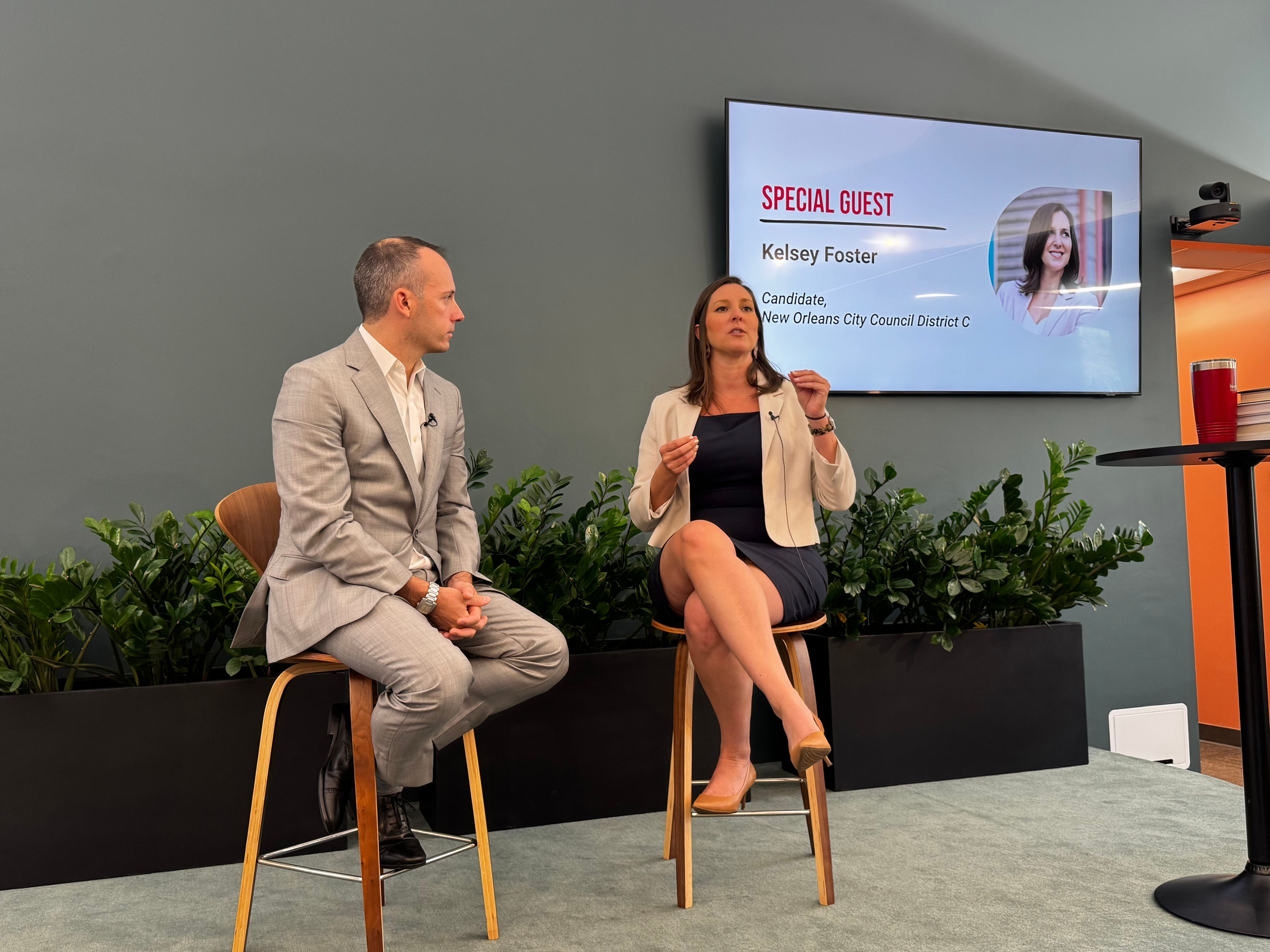
Foster says the fastest way to grow housing, retail, and jobs in District C (Algiers Point to the French Quarter/Bywater/Tremé) is painfully simple: make the rules clear and consistent. “You should not ever need a Kelsey Foster to go get your permit from City Hall. You are owed that as a resident and as a business owner,” she told our agents.
Why it matters: Project timelines and capital follow certainty. New Orleans is competing every day with Jefferson Parish, Houston, and growing Sun Belt markets. A clean, predictable process is—quite literally—economic development. (For context, Houston is piloting a 20-day “shot clock” for many permits—miss the window, the city auto-approves with conditions. It’s controversial, but it’s clear.)
Catch up quick
Short-term rentals (STRs): A new Commercial STR study is headed to the next Council. Any changes will shape hotel/STR balance, neighborhood quality-of-life, and housing supply.
English Turn lawsuit: A developer blocked by an interim zoning district (IZD) is suing the City, with the U.S. Department of Justice filing a Statement of Interest supporting claims that the IZD may violate the Fair Housing Act and Title VI. That keeps federal dollars on the table—and under scrutiny.
Budget fog: Watchdogs warn of a $100M-ish 2025 shortfall, driven by revenue softness and overtime spikes, while City officials dispute the severity. Translation: financial reporting has to tighten—fast.
By the numbers
Population pressure: The New Orleans metro has seen multi-year population declines, adding urgency to “make it investable” so people and projects choose Orleans, not elsewhere.
Workforce pipeline: University of Holy Cross in Algiers was just ranked #1 nursing school in Louisiana (RegisteredNursing.org 2026 list)—a big talent anchor for District C healthcare employers.
7 minutes dock-to-dock: The Algiers–Canal Street ferry runs roughly every 30 minutes; typical crossing ~7 minutes. That walkable connectivity is a real estate asset.
Restaurant momentum: Algiers Point’s dining scene—Plume, Nighthawk, more—continues to get citywide love, boosting neighborhood demand.
What we’re hearing (from Kelsey)
“Predictability…we have reputation work to do, and that’s real—on a national stage.”
“We’ve got to stop governing by exemption and loophole. Residents and developers both need fair, standard expectations.”
“I want us to balance our books ourselves—not with another disaster. Let’s run the city on time and on budget.”
Between the lines
Land use ≠ politics: Foster argues New Orleans too often makes by-right projects play a political game for height/density bonuses, chilling investment. That narrative tracks with the English Turn litigation timeline the DOJ recapped for the court. (Note: DOJ doesn’t judge the merits yet—it flags plausible FHA/Title VI issues at the motion-to-dismiss stage.)
Culture + compliance: On the French Quarter, Foster is pro-preservation and pro-efficiency—arguing solar panels/EV chargers shouldn’t be a bureaucratic gauntlet. MACCNO and City planning documents show how live-entertainment/venue rules remain a live debate.
What’s next
Council’s first tests: The Commercial STR study; sharper monthly financial reporting (BGR’s top ask); and a modernization plan for permits/One Stop that learns from peer cities instead of custom-coding our own headaches.
District C opportunities: De Gaulle Manor, Higgins Gate, Naval Support Facility in Bywater—sites that can move the needle on mixed-income housing and neighborhood retail if approvals get de-risked and sequenced. (Related: BGR’s April report urges better projections to avoid overtime-driven surprises.)
Reality check
New Orleans’ finances are under stress—and contested. BGR pegs a ~$100M 2025 gap; City leadership notes reserves and disputes the cliff. Either way, investors price uncertainty. Clear books + timely public dashboards would help everyone—from small landlords to national retailers—underwrite Orleans again.
KW New Orleans take
We’re bullish on District C—and we agree with Foster on the blocking and tackling:
Standardize: publish true by-right checklists; fast-fail incomplete apps.
Timebox: put service-level agreements on plan review (cue Houston’s shot-clock debate) and track them publicly.
Tell the story: leverage ferry-walkability + restaurant momentum in Algiers Point; highlight #1 nursing pipeline at UHC for employer recruitment.
For agents
District C is where policy, product, and place meet. If you’re an agent who wants a front-row seat—and a voice—in that conversation, KW New Orleans is the table where leaders talk real estate. Join our weekly sessions, meet the decision-makers, and help clients navigate the rules as they evolve.
Disclosure: This post summarizes a KW New Orleans conversation with a candidate for elected office and includes independent research. It’s not an endorsement.
This article was originally published on our website, which can be accessed here.