
Stop Being Busy, Start Being Strategic
Kristen Cronin, coach with KW MAPS Coaching, on why busyness is a choice, how to find your natural lead-generation entry point, and what it actually means to work strategically.
WHY IT MATTERS
If you’ve been feeling like the world is throwing an endless stream of new circumstances at you—market shifts, competing demands, the fog of a calendar that seems full but somehow doesn’t produce the results you want—you’re not alone. But according to one of the sharpest coaches working in real estate today, the problem isn’t the world. It’s the absence of a real strategy.
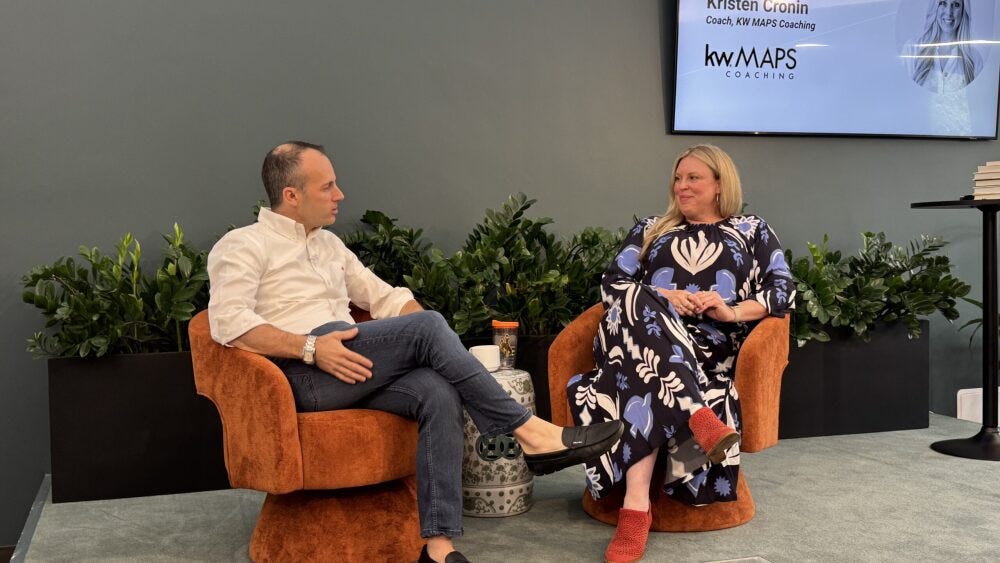
Kristen Cronin is a coach with KW MAPS Coaching, a former Team Leader of three market centers, and a co-founder of a coaching practice that works across industries beyond real estate. She stopped by KW New Orleans to talk with Operating Principal Jeffrey Doussan about what separates agents who thrive from those who stay stuck—and the answer she kept coming back to had nothing to do with market conditions.
Kristen Cronin
COACH — KW MAPS COACHING
Kristen Cronin didn’t arrive at coaching from a straight line. She led not one, not two, but three KW market centers as Team Leader before stepping into a coaching role that now spans real estate, land, wellness, and business-to-business clients across the country. She’s an educator for KW Land and KW Wellness—two divisions that might seem unrelated until you hear her explain how a GIS map and a listing appointment are solved by the exact same strategic framework. She and her partner split the work the way she teaches agents to split their lead generation: he’s property-driven, she’s people-driven, and together they’ve used that approach to get ahead of development deals before most agents even know a market is moving. The thing that sticks with you after talking to Kristen isn’t a tactic—it’s the uncomfortable realization that you already know what you need to do, and she’s just going to make you admit why you haven’t done it.
THE STATE OF PLAY
Before she got into frameworks and entry points, Cronin set the stage with a diagnosis. The restlessness agents are feeling right now isn’t a New Orleans problem, a market-cycle problem, or a Jazz Fest distraction problem. It’s a human condition—and it’s being made worse by a specific set of defaults most agents don’t realize they’re running.
Prescribed processes feel like productivity. Running a checklist of standard activities can look like high function—and feel like a full day—without moving the needle on actual outcomes. Cronin calls this being stuck in prescriptive mode: doing the thing because it’s the thing, not because it produces what you want.
Reactive cycles are the default setting. Most agents, she argues, are making decisions after something has already happened—adjusting on the fly rather than getting ahead of the variables. The market changes, a client goes sideways, a deal falls through—and then they respond. Strategy means reversing that sequence.
Mismatched communication kills conversion. Cronin told an agent on a coaching call that same morning: “You’re giving information in listing appointments in the way that you process it. Your clients do not process it that way.” Speaking your own language to someone who processes differently is why agreements don’t get signed.
Visibility gaps, not lead shortages. “You don’t have a lead problem,” Cronin said plainly. “You have a visibility problem.” Most agents have thousands of contacts in their phones and are dramatically underworking the relationships already in front of them.
“You can either proactively get ahead of those things and have a strategic plan that changes with the adaption of whatever’s changing in your market around you or in your life around you. It’s a human condition. It happens in all industries. It happens to all people, so it’s not unique. But the problem is we aren’t dealing with it strategically.”
— KRISTEN CRONIN, COACH, KW MAPS COACHING
OPPORTUNITY ENGINEERING
Cronin’s term for intentional, proactive business development is opportunity engineering—and it starts with a question most agents skip entirely: what do I actually want out of this? Not the transaction. Not the commission. The specific outcome, mapped backward into daily activities.
The framework she uses involves layering variables: what’s the timing, who are the relationships, who holds influence, what’s the asset, what’s the environment? Running through those questions before acting—rather than defaulting to whatever prescribed process is most familiar—is what separates strategic work from the appearance of it. “It feels like a story problem,” she said. “There’s probably like 50 scenarios off of this moment. Let me figure out what’s the most strategic and proactive, what’s going to produce the outcome that I want.”
She’s quick to acknowledge this takes practice. The payoff is the ability to move fast once you’ve done the slow thinking—running through variables like a system upgrade that eventually becomes second nature.
TWO ENTRY POINTS: PERSON OR PROPERTY
One of the most clarifying ideas Cronin introduced—and one she said almost nobody talks about explicitly—is that every lead-generation approach begins at one of two entry points: you either start with a person and move toward a property, or you start with a property and move toward a person.
The distinction isn’t just academic. It maps directly to personality. Agents who love working FSBOs and expireds are property-entry people: they come in through the asset and find the human on the other side. Agents who thrive on community relationships, referrals, and life-transition conversations are people-entry: they lead with connection and let the property follow. Neither approach is superior—but fighting against your natural entry point is a fast path to burnout and call reluctance.
Cronin and her partner are a real-world example of this in action. He monitors city and county GIS data, tracks development pipelines, and spots underutilized land before anyone else is looking—classic property-entry thinking. She builds the people relationships. Together, they’ve used that division to secure a development deal for over 200 homes in a market about to receive a significant wave of new industry. The point she drove home: both sides of that deal were engineered, not stumbled into.
“You don’t have a lead problem. You have a visibility problem, most likely, and you also have a strategy problem.”
— KRISTEN CRONIN, COACH, KW MAPS COACHING
DATABASE, SEGMENTATION & THE MESSAGE PROBLEM
A phone full of contacts is not a database strategy. Cronin is direct about this: if your database isn’t segmented into meaningful buckets, you’re sending the same message to people with completely different needs—and wondering why nothing converts.
She breaks a working database into three layers: now business (people actively in a transaction or close to one), next business (people in the pipeline with a horizon of months), and network influence business (the relationships who will refer and amplify). Each layer requires a different message, a different frequency, and a different value proposition. Blanketing all three with the same email or text is the equivalent of giving your listing presentation the same way to every client regardless of how they think.
This is where business-to-business relationships become a major lever. Cronin walked through the math of a client’s journey: from first contact through closing and beyond, there are potentially 150 or more business categories that touch that same client for different reasons. Mortgage, title, inspection, storage, interior design, landscaping, childcare—anyone who shares your client is a potential referral partner. The strategic move is to map that ecosystem, identify who has your clients, and build intentional relationships with those businesses rather than waiting for referrals to arrive organically.
LEVERAGE, TIME AUDITS & THE DOLLAR-PER-HOUR REALITY
Cronin draws a hard line between work that belongs on your plate and work that doesn’t. The exercise she returns to repeatedly: draw a line down a piece of paper, put your name on the left, put everything else on the right, and place only the activities that represent your highest-and-best use on the left side. Everything else gets delegated, systematized, or handed to technology.
Leverage, she explains, takes three forms: a person, a technology, or a system and process. Inserting any one of them into the right spot can recapture hours that are currently being spent on tasks that pay you far less than your target income requires. The math is unforgiving—if you’re spending your hours on $15-per-hour administrative work, that’s effectively the wage you’re paying yourself for that time, regardless of what your commission split looks like on paper.
She also raised the opposite problem: agents who aren’t working enough hours to match their income expectations. A coaching client she worked with recently revealed they were putting in seven hours—for the week. “You literally have less than a part time job,” she told them, “and that’s why your bank account reflects that.” Her recommendation is a time-tracking audit: log actual hours against actual activities for a week, then let the numbers tell you the story.
“Stop thinking in transactions. Start thinking in networks.”
— JEFFREY DOUSSAN, OPERATING PRINCIPAL, KW NEW ORLEANS
THE 30-DAY COMMITMENT & WHERE TO START
Cronin closed with a challenge that’s intentionally simple, because she’s seen what happens when agents try to run ten strategies at once: nothing grows. The directive is to pick one approach, commit to it for at least 30 days without deviation, and let it produce data before changing anything.
The starting actions are concrete. Identify 200 VIP contacts from your database. Assign every one of them to a segment. Decide your entry point—person or property—based on where you naturally operate. Then initiate ten conversations this week. Not automated messages, not bulk texts, not a newsletter blast—actual conversations, shaped by what you know about each person and what you actually want from the interaction.
She’s also clear that a schedule is not a strategy. DTD2—the Keller Williams “Daily Two” contact framework—is a useful structure, but it doesn’t tell you who to call, what to say, or how to match the message to the moment. That’s the strategy layer, and it has to be built separately, revisited quarterly, and run with enough consistency to actually generate signal.
THE BOTTOM LINE
Kristen Cronin’s core argument is that most agents aren’t under-working—they’re misallocating. The busyness is real, but it’s built from prescribed processes and reactive habits that feel productive without engineering specific outcomes. Her fix isn’t a new script or a shinier CRM: it’s identifying your natural entry point (person or property), segmenting your database into now, next, and network layers, and running one focused strategy for 30 days before touching anything else. The agents who do the slow strategic thinking first—variables, timing, relationships, intent—are the ones who stop chasing leads they don’t have and start harvesting the business already sitting inside the networks they’ve built. That shift, Cronin would say, is entirely a choice.
About this series. KW New Orleans hosts regular conversations with the leaders shaping our city — developers, architects, investors, and operators building the New Orleans of tomorrow. These are the conversations that happen in the rooms most people don’t get invited into.
Disclaimer: This article is provided for general informational purposes only and reflects a summary of a public conversation. It is not legal advice, public safety guidance, or a guarantee of outcomes. Laws, policies, and crime trends can change, and individual situations vary. For questions about legal matters, consult a licensed attorney. For real estate questions, consult a licensed real estate broker, and verify any neighborhood-specific concerns through appropriate official sources.
This article was originally published on our website, which can be accessed here.