
New Orleans Real Estate in 2026: What the Data Means Right Now
KW New Orleans breaks down what national housing data, local market numbers, and insurance pressure really mean for New Orleans buyers, sellers, and agents.
New Orleans real estate is changing…and the people who can explain it are gaining ground
1 Big Thing
The national housing market is still slow, cautious, and affordability-constrained. New Orleans is not immune…but it is moving differently. Sales are picking up locally, prices remain relatively stable, buyers have more room than they did a few years ago, and the biggest challenge is no longer just finding a house. It is making sense of the market.
That is where KW New Orleans is leaning in.
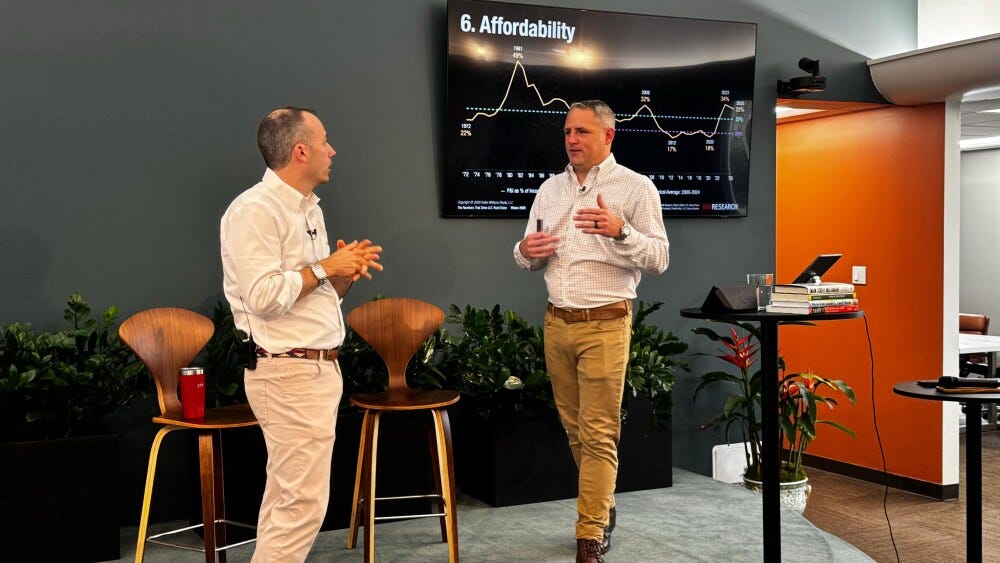
In a recent market and industry conversation, Team Leader Cody Caudill and Operating Principal Jeffrey Doussan did more than recap headlines. They translated the moment. They connected national data to local reality. They explained what matters, what does not, and where consumers and agents alike need better judgment.
That is increasingly what leadership looks like in real estate.
Why it matters
There is too much generic housing content in the world right now.
Nationally, existing-home sales remain weak. NAR reported that January 2026 existing-home sales fell to a seasonally adjusted annual rate of 3.91 million, down 8.4% from December and down 4.4% year over year. Inventory improved to 3.5 months of supply nationally, but affordability remains a major drag.
At the same time, mortgage rates have improved from where they were a year ago. Freddie Mac reported the average 30-year fixed-rate mortgage at 6.00% on March 5, 2026, versus 6.63% a year earlier. The 15-year fixed averaged 5.43%, down from 5.94% a year earlier.
That is the national backdrop.
But Cody and Jeffrey’s core point was this: New Orleans does not move in lockstep with the national script. It never really has.
This is a city with unusual seasonality, older housing stock, flood and insurance considerations, neighborhood-level fragmentation, and a consumer base that often reacts differently than buyers in more uniform suburban markets. The right question is not “What is the market doing?” The right question is “What is the market doing here?”
The New Orleans numbers
Locally, the story is more active than the national mood suggests.
According to the New Orleans Metro Association of Realtors market snapshot for January 2026, the 10-parish metro posted:
new listings up 2.8% year over year
pending sales up 25.4%
closed sales up 17.1%
median sales price up 0.6% to $276,700
average sales price up 1.3% to $361,909
affordability index up from 104 to 111
inventory down 6.5% to 5,515 homes
months of supply down from 6.1 to 5.4
days on market up from 71 to 75
percent of list price received easing only slightly from 96.7% to 96.5%
That is a very specific kind of market.
It is not overheated.
It is not frozen.
It is not exploding upward on price.
It is not collapsing either.
It is rebalancing…with real activity, measured pricing, and selective demand.
That is why KW New Orleans keeps hammering local interpretation. A city can post stronger sales and still require sharper pricing strategy. A buyer can have more opportunity and still feel uncertain. A seller can see momentum and still miss the mark if they price like it is 2021.
What Cody and Jeffrey saw clearly
The strength of the conversation was not just that it used data. It was that it explained the behavior behind the data.
Cody framed the national economy, mortgage-rate expectations, inventory trends, and affordability pressures through the lens of what they mean for New Orleans consumers now. Jeffrey pushed where headlines oversimplify, especially on rates, sentiment, and industry structure.
Together, they made three points that matter.
First…consumer confidence is a bigger issue than many people realize.
Jeffrey said it directly: “The enemy of the stock market, of home buyers, of our psyches, is uncertainty.”
That line explains a lot of what the market feels like right now. Buyers are not only reacting to rates. They are reacting to the economy, insurance costs, politics, job security, and the simple fear of making a major financial decision at the wrong time.
Second…waiting on the Fed is not a strategy.
As Cody and Jeffrey emphasized in the room, there is a major difference between headlines about Fed policy and the mortgage rates buyers actually get quoted. That aligns with what the broader market shows. Mortgage rates are shaped by Treasury yields, investor expectations, and mortgage spreads…not just one central-bank announcement.
Jeffrey put it bluntly: “Lowering the Fed funds rate is not…you’re not going to see a big change in mortgage prices.”
That matters because many buyers are still telling themselves a story that a dramatically better rate environment is just around the corner. Maybe rates improve somewhat from here. Maybe they do not. But the local opportunity today may come more from negotiation, inventory choice, and moderated pricing than from waiting for a headline to save the deal.
Third…the future belongs to agents who can actually explain the market.
That is where KW New Orleans is trying to separate itself.
Not by pretending hard topics do not exist.
Not by handing out shallow scripts.
Not by treating agents like passengers.
But by building a place where professionals are expected to understand the market deeply enough to guide others through it.
That is why this line hit: “Which side do you want to be on…where you’re an entrepreneur, where you own a business…”
That was not just a cultural statement. It was a market statement. In a more selective, more complicated environment, the best agents are not the loudest. They are the clearest thinkers.
New Orleans is not following the same pricing story
One of the most important realities in the local market is that price growth has stayed relatively restrained.
Nationally, the last several years distorted expectations. Many consumers still assume real estate either has to soar or crash. New Orleans has been more measured.
The NOMAR January 2026 metro numbers show exactly that. Sales activity is rising much faster than prices. Closed sales rose 17.1% year over year, while the median sales price rose just 0.6%. Average sales price rose 1.3%. Days on market increased, and sellers received slightly less than list on average than they did a year ago.
That lines up with what Cody and Jeffrey were discussing in broader form: activity is returning, but not in a frenzy. Sales are moving, but buyers are still careful. Pricing is holding, but not surging.
That is actually good news for serious market participants.
For buyers, it means there may be room to negotiate.
For sellers, it means preparation matters.
For agents, it means pricing advice has to be smarter than “just test the market.”
The insurance reality is still local, not theoretical
Any honest New Orleans market analysis has to talk about insurance.
National affordability coverage still tends to lean heavily on principal, interest, and general payment ratios. In South Louisiana, that is incomplete. Insurance can materially change affordability, buyer psychology, and lender comfort.
The state has acknowledged that directly through the Louisiana Fortify Homes Program, which offers grants of up to $10,000 for qualifying homeowners to upgrade to the IBHS FORTIFIED Roof standard. The goal is resilience and, over time, better insurability.
That does not eliminate the pressure. It does reinforce what KW New Orleans keeps teaching: in this market, agents need to understand more than price per square foot. They need to think through roof age, mitigation, flood exposure, premium volatility, and total monthly cost.
That is not extra credit anymore. That is the job.
Where KW New Orleans is planting its flag
The market update also made something bigger clear.
KW New Orleans wants to be the place where the real conversation happens.
That means:
reading national data without becoming captive to it
explaining local market conditions with precision
discussing industry change without hiding from controversy
equipping agents to lead with knowledge, not noise
giving consumers something more useful than recycled housing cliches
That positioning matters in New Orleans.
This is a city that responds to authenticity. People here know when someone is faking expertise. They also know when someone understands the block, the building, the insurance issue, the timing, the neighborhood politics, the historical context, and the actual economics of the decision.
That is the lane Jeffrey and Cody were occupying in this conversation…not as commentators, but as interpreters. Not as hype men, but as market leaders.
Bottom line
The national housing market is still soft. Existing-home sales are down. First-time buyers are under pressure. Mortgage rates are better, but not easy.
New Orleans is different.
Locally, pending sales are up 25.4%. Closed sales are up 17.1%. Prices are growing slowly. Inventory is more balanced than the panic years. The market is active enough to create opportunity and nuanced enough to demand real judgment.
That is why voices like Jeffrey Doussan and Cody Caudill matter right now. They are not just reporting numbers. They are explaining what the numbers mean for this city.
And that is where KW New Orleans is making its case…as the brokerage where leaders talk real estate, where difficult subjects get addressed directly, and where optimism is grounded in actual knowledge.
New Orleans does not need more noise.
It needs people who know how to read the market…and lead through it.
Disclaimer: This article is for general informational purposes only and is based in part on commentary shared during a KW New Orleans market and industry discussion. Market conditions, mortgage rates, insurance trends, and legal requirements may change. Nothing in this article is legal, tax, insurance, or financial advice. Consumers and agents should consult the appropriate licensed professionals regarding their specific situation.
This article was originally published on our website, which can be accessed here.