
Inside the Fight Against Hunger with Second Harvest’s Lindsay Hendrix
Driving the news:
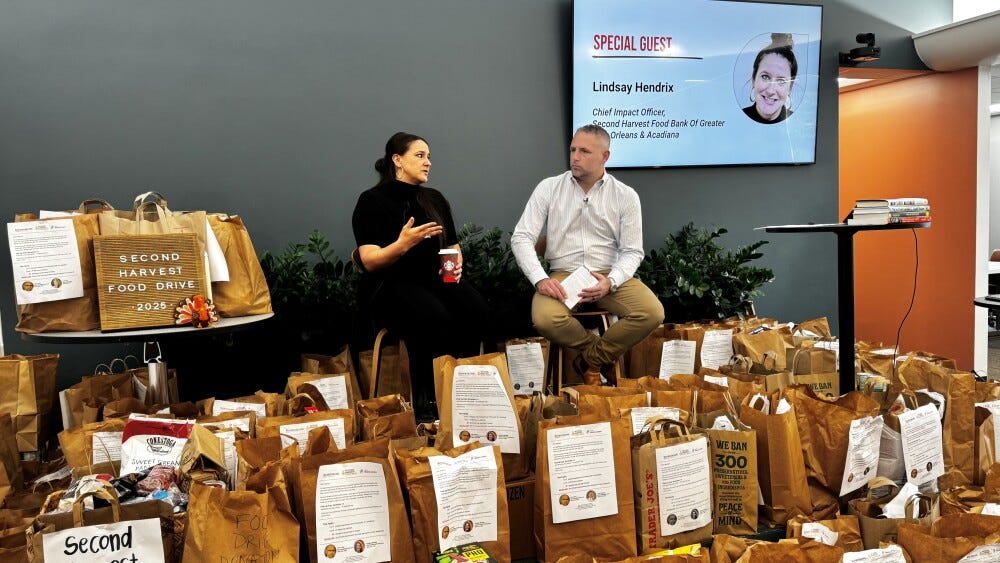
New Orleans is facing one of the most challenging food insecurity spikes in more than a decade — and Second Harvest Food Bank is at the center of the response. This week, KW New Orleans welcomed Lindsay Hendrix, Chief Impact Officer of Second Harvest, for a powerful and deeply human conversation about SNAP changes, rising need, and what hope looks like in a year of crisis.
The room was packed. The energy was high. And Lindsay gave us the kind of leadership insight that reminds us why we host these conversations in the first place: because real estate professionals are community leaders — and community leadership starts with understanding the needs of our neighbors.
Why it matters
Second Harvest feeds families across 23 parishes, and the demand has surged at a pace few predicted.
In 2022, the food bank served 109,000 households per month.
By early 2023, it jumped to 140,000.
This fall, it reached nearly 150,000 households — in just one month.
And according to Lindsay, that growth is not slowing.
“The panic that our community was facing — the worry, the sleepless nights — it was unlike anything we’ve ever seen,” she told the room.For real estate agents, developers, lenders, and policymakers, these numbers are not abstract. Food insecurity touches housing stability, neighborhood well-being, public health, and the overall resilience of our city.
The big picture: SNAP turmoil and policy shake-ups
Lindsay broke down the major changes hitting Louisiana families, driven by both federal uncertainty and recent state-level decisions. These shifts include:
1. SNAP (food stamp) benefits were at risk during the federal shutdown drama.
Although SNAP is an entitlement program — meaning benefits should continue even without new appropriations — political brinksmanship left states scrambling.
Louisiana responded faster and more boldly than many others.
“I’m really grateful for our state’s leadership,” Lindsay said. “There were very few states that acted the way ours did — and none in the South.”Louisiana fronted emergency dollars to keep benefits flowing, prioritizing seniors, people with disabilities, and households with children.
2. New federal rules now require more people to work to receive benefits.
This includes:
Raising the age for work requirements
Changing how dependents are defined
Talk of forcing everyone to reapply at once
These changes disproportionately affect low-income families, seniors approaching retirement, and people recovering from illness or job loss.
3. States will soon carry a heavier load.
Under new policy proposals, states could be required to cover a much greater share of total SNAP benefits, not just administrative costs — a massive shift for poorer states like Louisiana.
A year of turbulence at Second Harvest
Lindsay didn’t sugarcoat it.
Between SNAP uncertainty and the high-profile split with the Archdiocese of New Orleans, 2025 became the most difficult year of her career.
She described donor confusion, paused contributions, and months of rebuilding trust. Their largest donor froze a $1 million gift for weeks. The team weathered leadership changes and public scrutiny — all while serving record-breaking demand.
But then something extraordinary happened:
An anonymous donor quietly stepped in to cover Second Harvest’s portion of the bankruptcy settlement. The food bank was spared from diverting critical operating funds.
“Honestly, I don’t care who they are,” Lindsay laughed. “Bless them.”The room erupted — because sometimes hope really does walk through the door unannounced.
What hunger really looks like in New Orleans
Lindsay reminded everyone that the stereotype of “the hungry” rarely matches reality.
The face of food insecurity today includes:
Seniors living on fixed incomes
Families between jobs
Parents working multiple part-time roles
People recovering from medical emergencies
Neighbors who just need help for a few months during a crisis
“Most people just need a little boost during a time of great need,” she explained.She shared the story of a man whose car broke down while in line at a food distribution. His neighbor — also in line — hooked a rope to his bumper and towed him through the line so he wouldn’t go home without food.
“That,” Lindsay said, “is community.”
How KW agents are showing up in their own neighborhoods
That same spirit of community has been on full display through KW New Orleans agents over the last few weeks.
Agents across the metro area have turned our annual food drive into a neighborhood movement — knocking on doors, sharing drop-off locations, and inviting their spheres to participate. Together, KW New Orleans agents have helped gather thousands of pounds of food, block by block.
It’s a natural connection:
Neighbors know their agents.
Agents know their communities.
And when a trusted local agent says, “Hey, let’s help Second Harvest fill some shelves,” people show up.
This is what we mean when we say real estate is a relationship business. It’s not just about closings — it’s about caring enough to show up when the city needs you.
What’s next: Systemic change starts locally
Lindsay’s call to action was clear:
Vote.
Call your representatives.
Pay attention to what’s happening at the state level.
Support organizations tackling root causes, not just symptoms.
She reminded us that legislators do listen to constituents — and that one of the most powerful things we can do is turn our frustration into phone calls, emails, and votes.
KW New Orleans will continue amplifying her insights, sharing her policy updates, and connecting our agents with ways to advocate for the city we love.
The bottom line
Lindsay Hendrix showed us what leadership looks like when the stakes are high: honest, compassionate, informed, and rooted in community.
At KW New Orleans, we believe real estate leaders should be civic leaders.
That’s why we bring the brightest voices — economists, preservationists, bankers, nonprofit innovators, policymakers — into our market center each week.
Because shaping the future of New Orleans takes all of us.
Want to join a brokerage that leads conversations that matter?
KW New Orleans isn’t just a place to sell homes — it’s a community of leaders shaping the future of our city.
If you’re an agent who wants to grow your business and your impact, let’s talk.
Disclaimer: This post is for informational purposes only and is not legal or policy advice. For questions regarding SNAP or public benefits, consult official state resources or an attorney.
This article was originally published on our website, which can be accessed here.